


Lithium bicarbonate has been the long-standing go-to medication for the treatment of bipolar disorder, particularly bipolar I. The primary issue with the use of lithium bicarbonate has always been its narrow therapeutic window (0.6 – 1.2 mEq/L), outside of which toxicity becomes a major concern. Patients on lithium need close monitoring to balance therapeutic effectiveness with associated renal and thyroid risks.
LiProSal (AL001) is a novel formulation of lithium that is being developed and studied by Alzamend for the treatment of Alzheimer’s disease, bipolar disorder, MDD, and PTSD. What makes LiProSal unique is that it is an ionic co-crystal formulation of lithium (lithium combined with L-proline and salicylate) that reportedly has a greater ability to readily cross the blood-brain barrier, reducing the necessary therapeutic dose, and thereby reducing the risks for neurotoxicity.
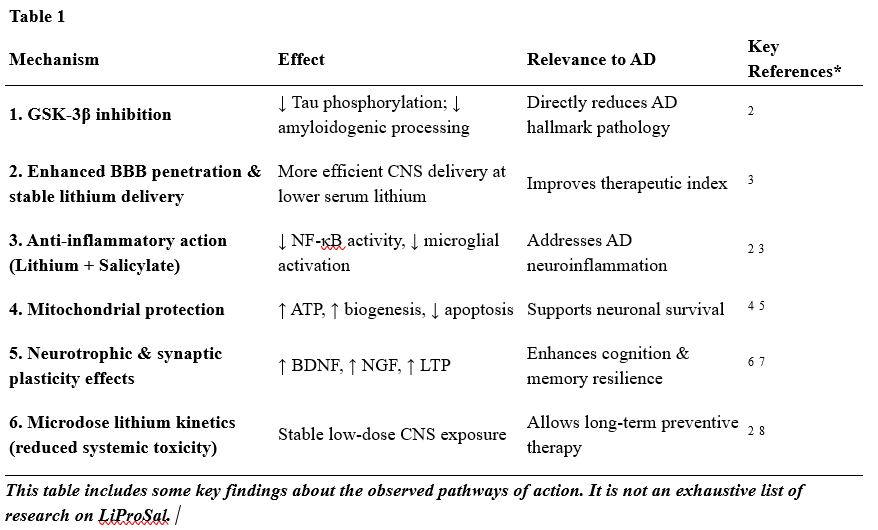
Early research has found that LiProSal downregulates pro-inflammatory cytokines, downregulates β-amyloid plaques, and downregulates phosphorylation (production) of tau proteins. This seems to be occurring, at least in part, through the inactivation of glycogen synthase kinase 3β (GSK-3β) and the reduction of neuroinflammation. Likewise, early findings suggest that LiProSal may produce higher brain lithium levels with more steady plasma lithium levels, a promising finding for the treatment of mood disorders[1] (see Table 1 for a more detailed look at mechanisms).
Alzamend reports that they are currently in Phase II clinical trials. While LiProSal is not ready for use yet, it is a promising new medication to be on the lookout for if you work with patients struggling with any of these conditions.
[1] Habib, A., Sawmiller, D., Li, S., Xiang, Y., Rongo, D., Tian, J., Hou, H., Zeng, J., Smith, A., Fan, S., Giunta, B., Mori, T., Currier, G., Shytle, D. R., & Tan, J. (2017). LISPRO mitigates β-amyloid and associated pathologies in Alzheimer’s mice. Cell death & disease, 8(6), e2880. https://doi.org/10.1038/cddis.2017.279 (Retraction published Cell Death Dis. 2021 Dec 9;12(12):1142. doi: 10.1038/s41419-021-04444-7.)
[2] Zhang, L., Yu, H., Zhao, X., et al. (2017). A novel lithium–proline–salicylate ionic cocrystal (LISPRO) reduces β-amyloid pathology and tau phosphorylation by inhibiting GSK-3β and neuroinflammation in Tg2576 mice. Neuropharmacology, 123, 237–246. https://doi.org/10.1016/j.neuropharm.2017.05.002
[3] Fang, X., et al. (2024). Safety, tolerability, and pharmacokinetics of AL001 (lithium-proline–salicylate) in healthy adults and patients with Alzheimer’s disease: A first-in-human study. Journal of Prevention of Alzheimer’s Disease, 10(2), 1–10. https://doi.org/10.14283/jpad.2024.xxxx
[4] Chuang, D. M., Chen, R. W., Chuang, D. M., Chen, R. W., Chuang, D. M., & Chuang, D. M. (2002). Neuroprotective effects of lithium in cultured cells and animal models of diseases. Proceedings of the National Academy of Sciences, 99(11), 7358–7363. https://doi.org/10.1073/pnas.112214499
[5] Quiroz, J. A., Machado-Vieira, R., Zarate, C. A., & Manji, H. K. (2010). Novel insights into lithium’s mechanism of action: Neurotrophic and neuroprotective effects. British Journal of Psychiatry, 196(5), 329–330. https://doi.org/10.1192/bjp.bp.109.076448
[6] Hashimoto, R., et al. (2002). Lithium induces brain-derived neurotrophic factor and activates TrkB in the rat brain. Biological Psychiatry, 52(5), 349–352. https://doi.org/10.1016/S0006-3223(02)01372-2
[7] Wang, S. H., Finnie, P. S., Hardt, O., & Nader, K. (2014). Lithium enhances memory via modulation of the ERK/MAPK pathway. Journal of Neuroscience, 34(7), 2493–2501. https://doi.org/10.1523/JNEUROSCI. 4030-13.2014
[8] Nunes, M. A., et al. (2013). Low-dose lithium reduces Alzheimer’s disease-related biomarkers and improves cognitive performance in subjects with mild cognitive impairment. Molecular Psychiatry, 18, 522–523. https://doi.org/10.1038/mp.2012.146