

Unlike most supplements marketed for mood, St. John’s Wort (Hypericum perforatum) has a substantial body of randomized controlled trials behind it.
This article aims to take a look at what St. John’s Wort actually is, what the clinical trials show, how it compares to standard antidepressants, why its mechanism explains both its benefits and its dangers, and what a thoughtful, evidence-informed take on it looks like. This applies whether you are a clinician reviewing a patient’s medication list, or a curious person wondering whether the bottle in your cabinet is worth taking.
What is St. John’s Wort, and what does it actually do?
St. John’s Wort is not one compound. It is a plant extract that contains several active constituent families: naphthodianthrones (hypericin and pseudohypericin), phloroglucinols (chiefly hyperforin), and flavonoids.
In the United States, St. John’s Wort is sold as a dietary supplement. This means that it is not FDA-approved for depression, and that the content and potency of commercial products vary widely.[1] It’s important to note that the trials that make up the evidence base did not use grocery-store capsules. They used pharmaceutically standardized extracts, most commonly WS 5570, ZE 117, and LI-160, calibrated to hypericin 0.1–0.3% or hyperforin 1–6%. Total daily doses ranged from 500 to 1,800 mg, most often 900 mg/day divided three times daily.[1]
As a consumer or professional making a recommendation, keep in mind that a study of a standardized extract tells you about that extract. It does not automatically tell you about the bottle a patient bought online or at the grocery store.
What the research shows
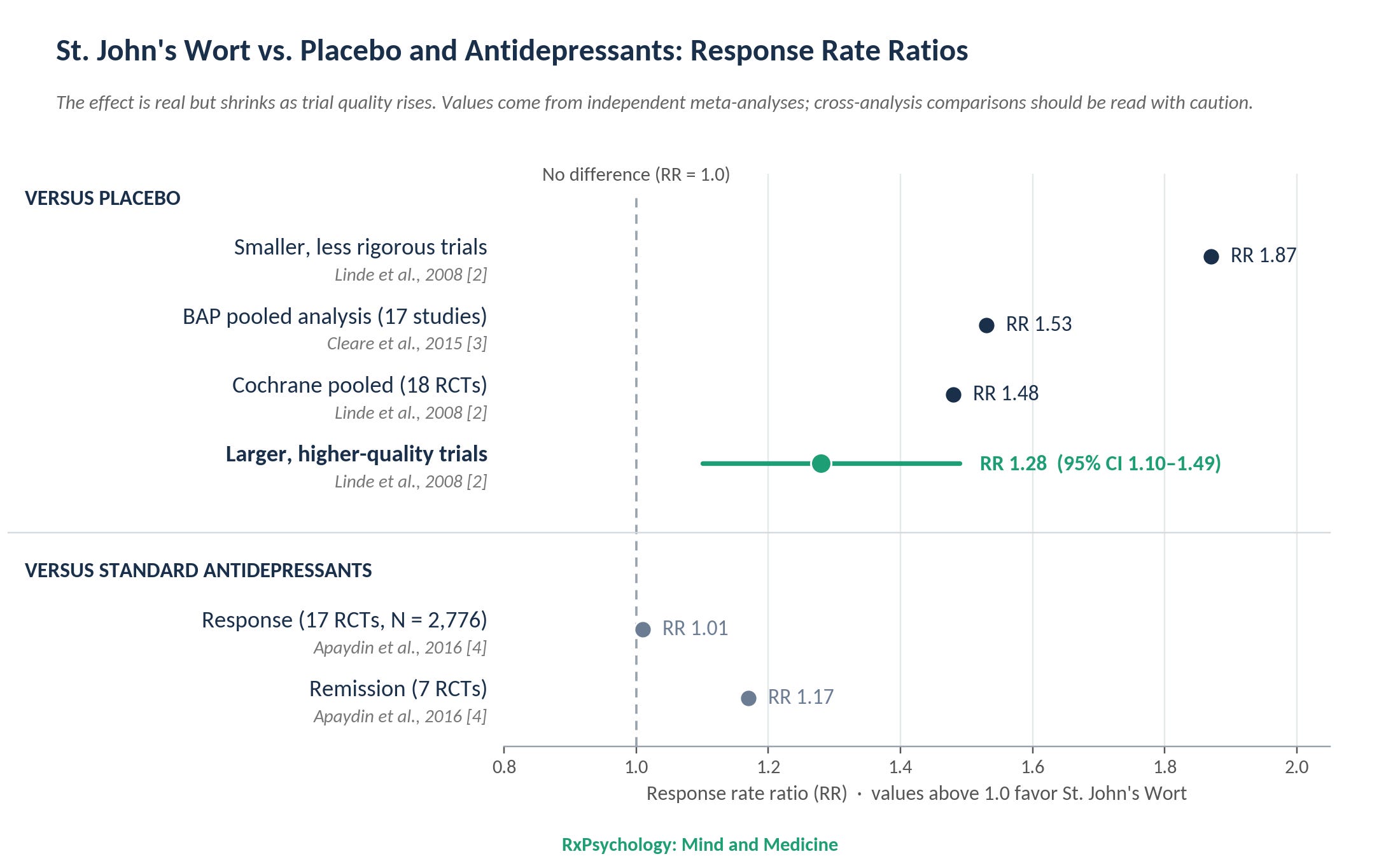
Figure 1. Response rate ratios for St. John’s Wort versus placebo and versus standard antidepressants. Sources: Linde et al. (2008) [2]; Cleare et al. (2015) [3]; Apaydin et al. (2016) [4]. RR > 1 favors St. John’s Wort. No single analysis covers all comparisons, so cross-study comparisons should be read with caution.
Compared to placebo
The 2008 Cochrane review pooled 18 placebo-controlled RCTs and found an overall response rate ratio of about 1.48 favoring hypericum.[2] The British Association for Psychopharmacology meta-analysis of 17 studies found response rates of 53% versus 35% (RR 1.53), a number needed to treat of 5–6.[3] The AHRQ/RAND systematic review found roughly a 3-point HAM-D advantage over placebo.[4] On this metric, St. John’s Wort is not obviously inferior to a conventional antidepressant in mild-to-moderate depression.
Important note
Look at the top half of Figure 1. In the Cochrane review, the effect shrank as trial quality rose: smaller, less rigorous trials produced an RR of 1.87, while larger, higher-quality trials produced an RR of 1.28 (95% CI 1.10–1.49).[2] That decline is consistent with small-study effects and publication bias. The RAND review also reported very high heterogeneity (I² ≈ 89%).[4] The effect is real and remains after restriction to better trials, but it is smaller than the headline numbers suggest.
Compared to antidepressants
Against active comparators, St. John’s Wort appears equivalent. The RAND review found no systematic difference from standard antidepressants in response (RR 1.01; 17 RCTs; N = 2,776), depression scores (SMD −0.03), or remission (RR 1.17).[4] The 2023 American College of Physicians network meta-analysis reached the same conclusion across 11 RCTs (1,697 participants) comparing it with citalopram, fluoxetine, paroxetine, and sertraline.[5]
The catch: several comparator trials used fixed and sometimes subtherapeutic SSRI doses, such as fluoxetine 10 mg/day.[5] “Equivalent to an underdosed SSRI” is a weaker claim than “equivalent to an SSRI.”
The best-designed trials
A 6-week RCT of 251 patients with moderate-to-severe depression (HAM-D ≥ 22) found WS 5570 at 900 mg/day superior to paroxetine 20 mg/day, by about 3 HAM-D points.[6] A three-arm double-blind trial (n = 135) found LI-160 at 900 mg/day superior to fluoxetine, though it only trended toward significance over placebo.[6] A 2026 network meta-analysis of nutraceuticals found WS 5570 and ZE 117 significantly outperformed placebo, but flagged effect sizes near SMD −1.0 as implausibly large and rated overall confidence low to very low.[7]
Severe depression
The 2002 U.S. Hypericum Depression Trial Study Group study is the trial most often cited to restrict St. John’s Wort to mild-to-moderate disease. In more severe MDD, St. John’s Wort did not separate from placebo.[6] But sertraline did not separate from placebo in that trial either. A study whose active control fails is better described as a failed trial than as a clean negative result.
Why this matters
The conclusion is not “St. John’s Wort fails in severe depression”, but rather, “the evidence in severe depression is inconsistent, and we have better options.” When the stakes include suicidality, functional collapse, or psychotic features, inconsistent evidence is reason enough to reach for something else.
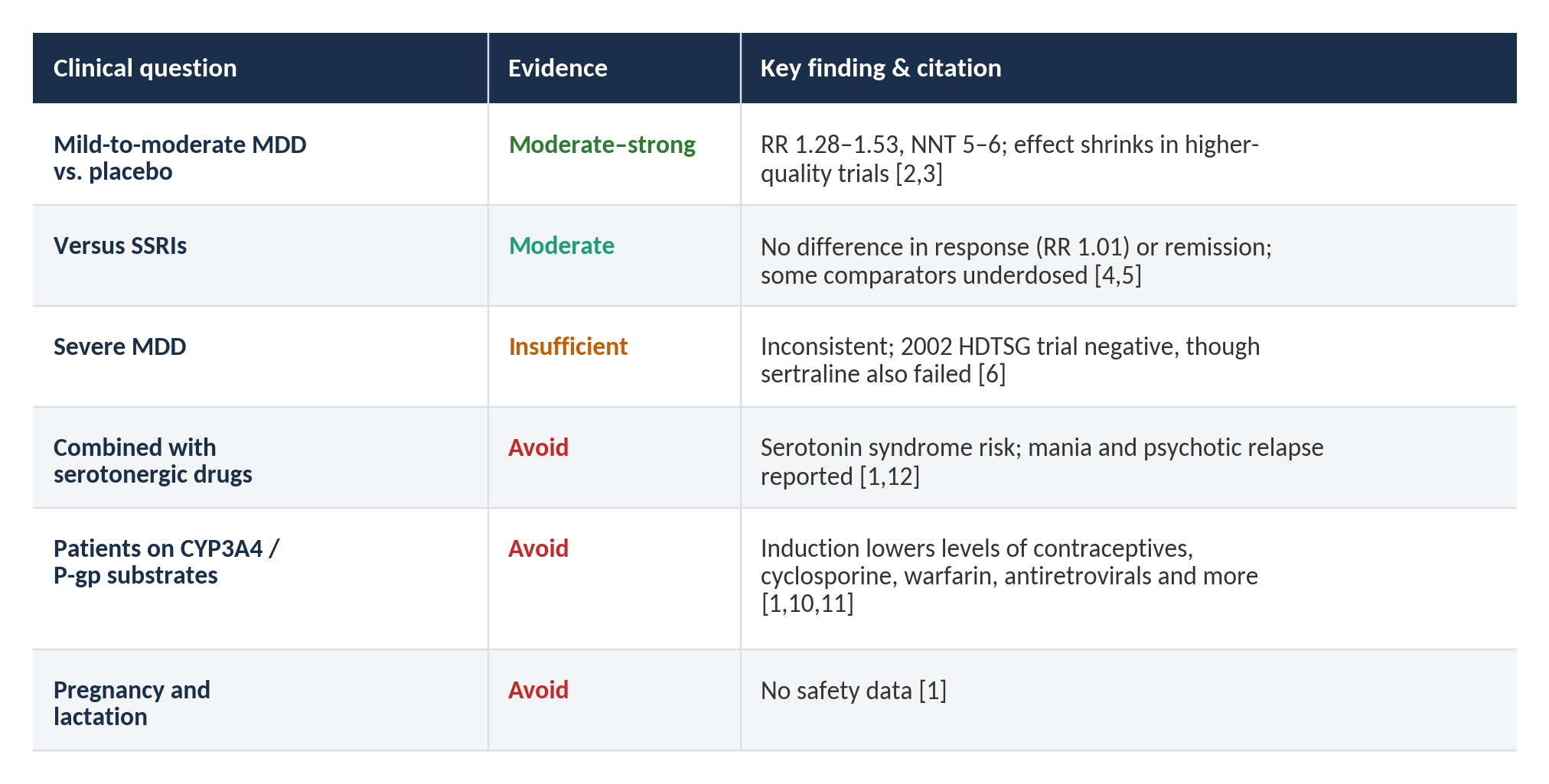
Question-by-question summary
What is the mechanism of action?
St. John’s Wort differs from most supplements: its core mechanism can be described in reasonable molecular detail.
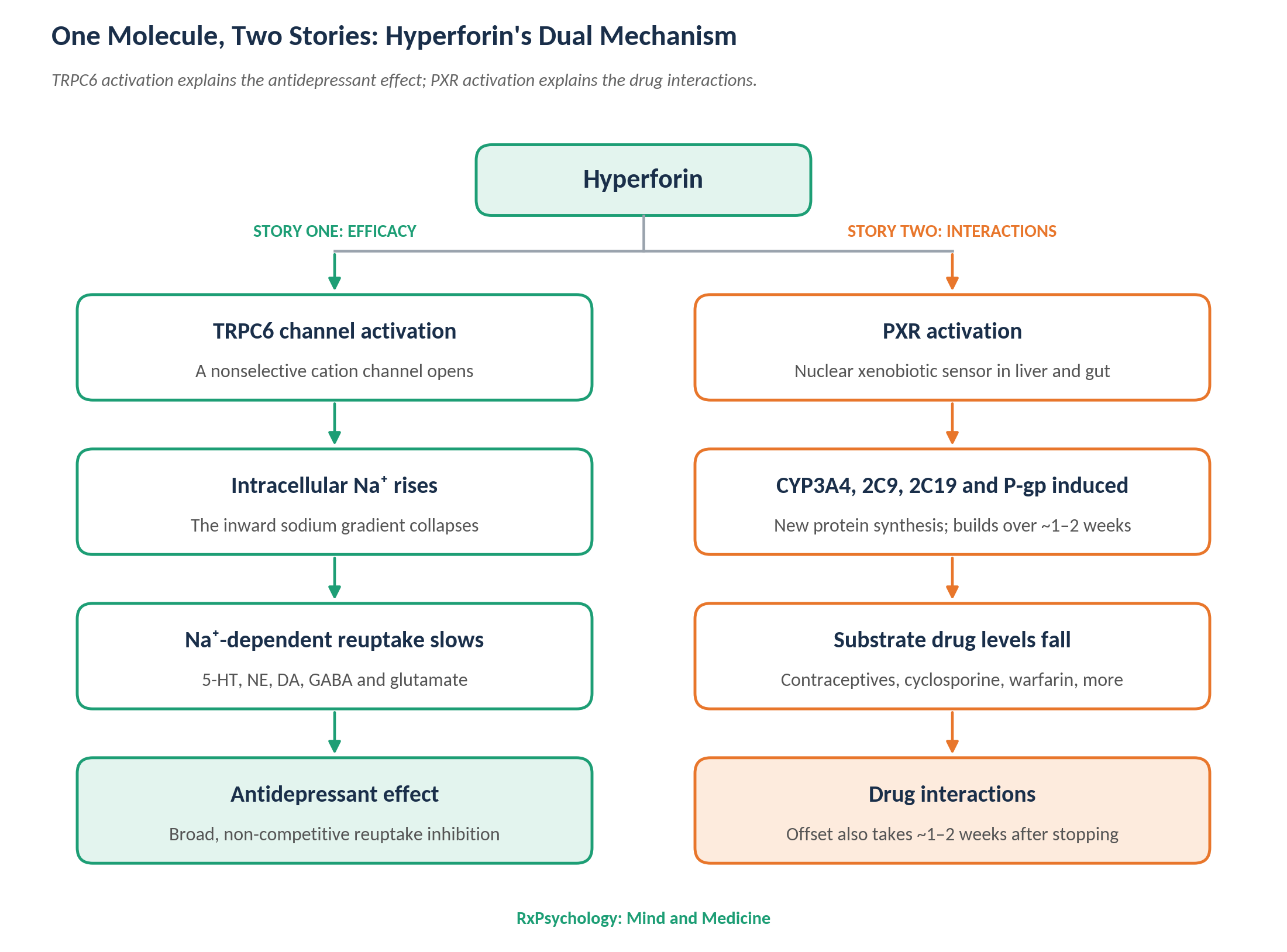
Figure 2. Hyperforin acts through two independent pathways: TRPC6 activation produces broad reuptake inhibition (left), while PXR activation induces drug-metabolizing enzymes and transporters (right). Sources: Leuner et al. (2007) [8]; Moore et al. (2000) [9].
1. Broad reuptake inhibition via TRPC6
Hyperforin inhibits reuptake of serotonin, norepinephrine, and dopamine, and also GABA and glutamate. Compared to SSRIs, which bind the transporter directly, Hyperforin instead activates TRPC6, a nonselective cation channel, which raises intracellular sodium.[8] Monoamine transporters are sodium symporters that run on the inward Na⁺ gradient. By collapsing that gradient, every Na⁺-dependent transporter slows at once, without anything occupying the transporter’s binding site.
2. Enzyme and transporter induction via PXR
Hyperforin is also a high-affinity ligand for the pregnane X receptor (PXR), the nuclear receptor that acts as the liver and gut’s xenobiotic sensor.[9] PXR activation upregulates transcription of CYP3A4, CYP2C9, CYP2C19, and the efflux pump P-glycoprotein (ABCB1). Because this requires new protein synthesis, induction builds over roughly one to two weeks, and it fades over a similar window after discontinuation.
3. Hypericin and photosensitivity
Hypericin is a photoactive compound, which helps explain the dose-related photosensitivity reported with St. John’s Wort.[6] Its contribution to the antidepressant effect is less clear than hyperforin’s.
The real methodological problems: why hold your enthusiasm in check
The St. John’s Wort literature is larger and better than most supplement literature. It still has weaknesses that any reader should understand. These are not minor quibbles:
The product is not the trial. The extracts studied were standardized; most commercial products are not. Content and potency vary widely across commercial products.[1] A positive trial of WS 5570 says little about an unstandardized capsule.
Publication bias and small-study effects. Effect sizes are largest in the smallest, least rigorous trials and shrink in the larger, higher-quality ones (Figure 1).[2] The 2026 network meta-analysis found the same pattern: larger effects tracked with lower study quality.[7]
Heterogeneity is very high. With I² around 89% in the RAND review, the trials are not measuring one consistent effect.[4] Populations, extracts, doses, and outcome measures all differ.
Some comparators were set up to lose. Several head-to-head trials used fixed, sometimes subtherapeutic SSRI doses.[5] Equivalence to an underdosed comparator is not equivalence to standard care.
Severe depression is undertested. The largest trial in more severe MDD was a failed trial, in which neither St. John’s Wort nor sertraline beat placebo.[6] We simply do not know enough to recommend it there.
The interaction problem
If efficacy were the whole story, St. John’s Wort would be an easy recommendation for mild-to-moderate depression. Most of our patients, however, take more than one thing. Its interactions fall into two mechanistic families.
Pharmacokinetic: PXR-mediated induction. CYP3A4 and P-gp induction lower exposure to a long list of drugs.[1,10,11]
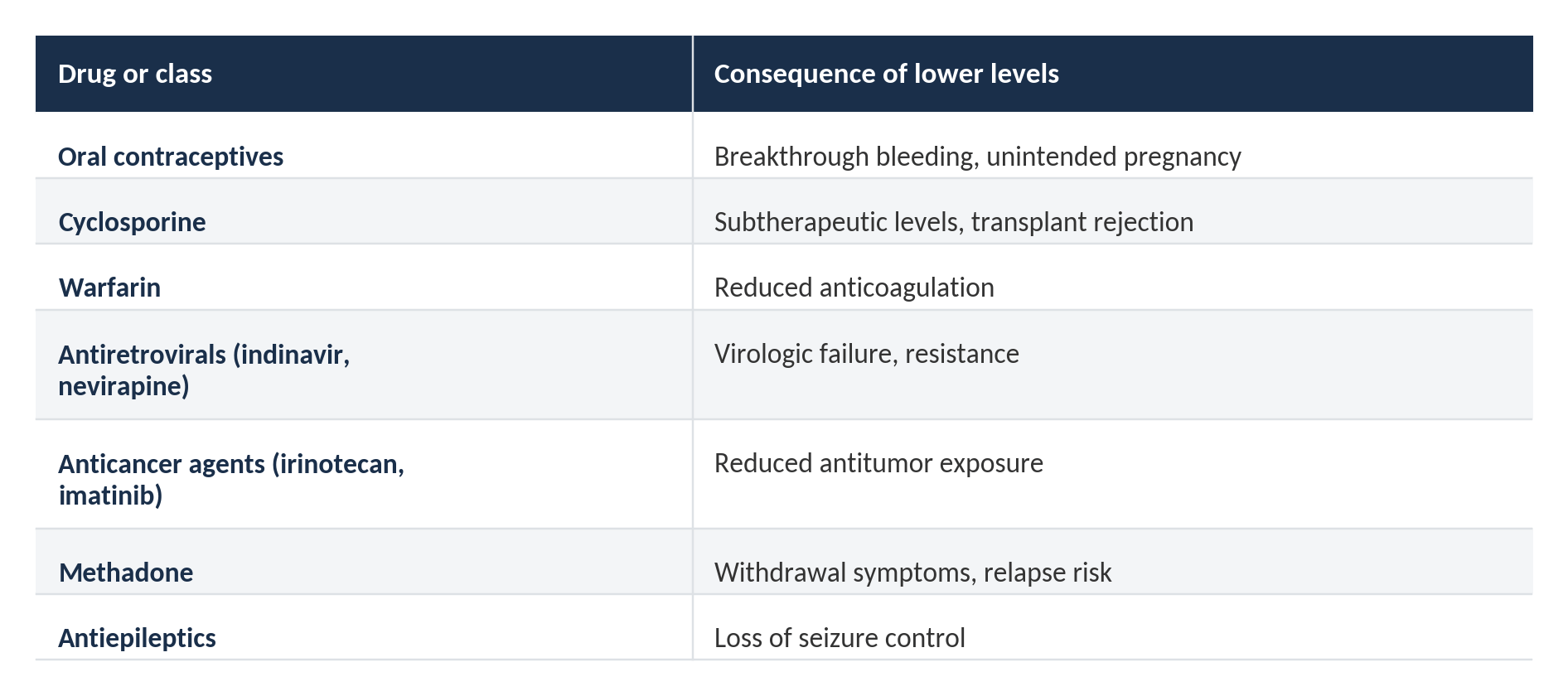
Pharmacodynamic: serotonergic load. Combining St. John’s Wort with SSRIs or other serotonergic agents can precipitate serotonin syndrome. Mania and psychotic relapse have also been reported.[1,12]
Psychopharmacology Application: Several psychotropics are CYP3A4 substrates. Alprazolam, quetiapine, lurasidone, buspirone, and buprenorphine all deserve a second look in a patient using St. John’s Wort; lurasidone labeling specifically contraindicates strong CYP3A4 inducers. Then check the serotonergic axis: triptans, tramadol, trazodone, and any planned SSRI or SNRI. Finally, plan the exit. When a patient stops St. John’s Wort, induction wanes over one to two weeks, and a substrate dose titrated during use can become a toxic dose after it.
Tollerability
As monotherapy, St. John’s Wort is well tolerated. It produces fewer adverse effects than standard antidepressants, with pooled adverse-event rates of 0–5.7%, comparable to placebo.[1,6,13] The most common effects are GI upset, mild sedation, restlessness, dizziness, and photosensitivity at higher doses. For a medication-averse patient taking nothing else, that tolerability advantage is clinically meaningful.
Standard cautions: Avoid in pregnancy and breastfeeding, where safety data are lacking.[1] Use caution in anyone with a bipolar diathesis, since mania has been reported.[1,12] And treat every other medication on the list as a potential interaction until proven otherwise.
Clinical Pearls
Clinical Pearl — The bottle is not the trial. Recommend only the standardized extracts that were actually studied. A grocery-store capsule inherits none of that evidence by default.[1]
Clinical Pearl — Hyperforin content predicts interaction risk. Because PXR activation is hyperforin-driven, low-hyperforin extracts such as ZE 117 appear to carry substantially less induction potential. If a patient is committed to St. John’s Wort and has a meaningful substrate on board, the specific extract matters.
Clinical Pearl — Ask by name. Patients often leave supplements off a “medications” list. Ask directly: “Do you take any herbal products, teas, or supplements for mood, sleep, or energy?”
Clinical Pearl — Plan the exit, not just the entry. Stopping St. John’s Wort is a medication change. Allow time for induction and serotonergic effects to clear before starting an SSRI or SNRI, and monitor narrow-therapeutic-index substrates as induction resolves.
So — is it worth it?
That depends entirely on what else the person is taking.
The bottom line
For mild-to-moderate depression: The evidence is good. St. John’s Wort beats placebo and performs comparably to SSRIs, with better tolerability as monotherapy.[2,3,4,5]
For severe depression: Not a first-line choice. The evidence is inconsistent, and better alternatives exist.[6]
For anyone on other medications: Oral contraceptives, anticoagulants, transplant drugs, antiretrovirals, opioid agonist therapy, many psychotropics, and any serotonergic agent all turn a reasonable option into a potentially risky one.[1,10,11,12]
For everyone: If you try it, use a standardized extract, set a defined trial period, and track it with a validated scale such as the PHQ-9. That turns an open-ended supplement purchase into a trackable intervention with a clear decision point.
If you are a clinician: Ask about St. John’s Wort by name, every time. Being able to say “here is where the data are reasonable, and here is why it is unsafe with your other medications” is far more useful than dismissal or uncritical enthusiasm.
If you are a patient or consumer: The depression data are good enough to take seriously. Tell every prescriber and pharmacist that you take it, and never start or stop it without telling them, because stopping changes your other drug levels too.
References
[1] Brockington, R., Buelt, A., Capaldi, V., et al. (2022). Management of major depressive disorder (MDD).
[2] Linde, K., Berner, M. M., & Kriston, L. (2008). St John’s wort for major depression. Cochrane Database of Systematic Reviews.
[3] Cleare, A., Pariante, C. M., & Young, A. H. (2015). Evidence-based guidelines for treating depressive disorders with antidepressants: A revision of the 2008 British Association for Psychopharmacology guidelines. Journal of Psychopharmacology.
[4] Apaydin, E. A., Maher, A. R., Shanman, R., Booth, M. S., Miles, J. N. V., Sorbero, M. E., & Hempel, S. (2016). A systematic review of St. John’s wort for major depressive disorder. Systematic Reviews.
[5] Gartlehner, G., Dobrescu, A., Chapman, A., et al. (2023). Nonpharmacologic and pharmacologic treatments of adult patients with major depressive disorder: A systematic review and network meta-analysis for a clinical guideline by the American College of Physicians. Annals of Internal Medicine.
[6] Sarris, J. (2018). Herbal medicines in the treatment of psychiatric disorders: 10-year updated review. Phytotherapy Research.
[7] Fornaro, M., Di Lorenzo, C., Nunez, N., et al. (2026). Nutraceuticals and phytoceuticals for the treatment of major depressive disorder: A systematic review and network meta-analysis. Molecular Psychiatry.
[8] Leuner, K., Kazanski, V., Müller, M., et al. (2007). Hyperforin — a key constituent of St. John’s wort specifically activates TRPC6 channels. The FASEB Journal, 21(14), 4101–4111.
[9] Moore, L. B., Goodwin, B., Jones, S. A., et al. (2000). St. John’s wort induces hepatic drug metabolism through activation of the pregnane X receptor. Proceedings of the National Academy of Sciences, 97(13), 7500–7502.
[10] Adiwidjaja, J., Boddy, A. V., & McLachlan, A. J. (2019). Physiologically based pharmacokinetic modelling of hyperforin to predict drug interactions with St John’s wort. Clinical Pharmacokinetics.
[11] Borrelli, F., & Izzo, A. A. (2009). Herb-drug interactions with St John’s wort (Hypericum perforatum): An update on clinical observations. The AAPS Journal.
[12] De Smet, P. A. (2002). Herbal remedies. New England Journal of Medicine.
[13] Varteresian, T., & Lavretsky, H. (2014). Natural products and supplements for geriatric depression and cognitive disorders: An evaluation of the research. Current Psychiatry Reports.
Disclaimer: This article is intended for educational purposes and does not constitute medical advice. It does not replace individualized clinical judgment or a relationship with a licensed healthcare provider. Clinicians should apply findings within the context of each client’s overall treatment plan.
RxPsychology: Mind and Medicine © 2026